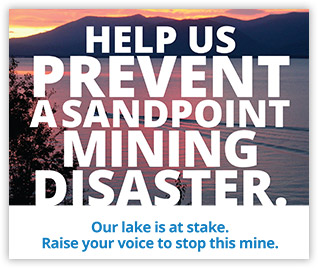
RCA Launches New Ad Campaign

“Help us prevent a mining disaster. Our lake is at stake.”

That’s the Rock Creek Alliance message as we enlists citizens to raise their voices against the Rock Creek Mine in a full page ad in the current Summer 2016 edition of Sandpoint Magazine. The ad is part of our ongoing efforts to raise awareness of the proposed mine.

help-prevent-mining-disaster

The ad points out the jeopardy to Lake Pend Oreille and Sandpoint, just downstream of the mine site.

“Sandpoint has everything to lose and absolutely nothing to gain from this monster of a mine,” the ad concludes.

Click to see the ad»
Click to read online edition of Sandpoint Magazine»

Comment Period For Draft SEIS

The Draft Supplemental EIS (DSEIS) for the proposed Rock Creek mine has been released for public comment by the Kootenai National Forest. If you are a long-term resident, you are probably familiar with this proposal and remember the controversial public hearings that took place in the mid-to late 90’s, the protest marches across the Long Bridge, and the series of lawsuits filed by the Rock Creek Alliance that have kept mine developers from turning ground.

The Rock Creek mine would be an underground copper/silver mine constructed beneath Montana’s Cabinet Mountains Wilderness. The mine would excavate 3.5 million tons of ore per year for 30 years, creating over 1 million tons of waste rock.

Not much about the mine has changed in the 15 years since the Forest Service first granted an approval:

The mine still proposes to create a perpetual discharge of heavy metals to the Clark Fork River, which supplies 90% of the water to Lake Pend Oreille. The cumulative impacts from this long-term discharge have never been analyzed.

The mine’s potential to create acid mine drainage has never been adequately quantified and has been consistently underestimated. Rather than using site-specific data, analyses rely on information from the Troy mine’s ore body, which contains less acid generating minerals.

One hundred million tons of mine waste would be stored next to the Clark Fork River in a pile covering over 300 acres and rising to a height of 300 feet. These tailings would generate seepage bound for ground water that would then enter the Clark Fork River.

The seismic safety calculations for this massive tailings dam don’t meet Montana’s regulations, and the construction method chosen is prone to failure. It’s the same method used at the Samarco Dam in Brazil, which collapsed in November killing 19 people and burying villages in the path of the mine waste. Experts estimate that between one and four breaches occur each year at tailings dams world-wide, roughly 10 times the failure rate of water dams.

The mine would deposit saturated “paste tailings’ on the surface rather than placing them in the underground mine void (backfilling). Nearly all modern mines use backfilling because it reduce the amount of tailings stored on the surface and the seepage of metals to ground water, while lowering the risk of an impoundment failure. Backfilling has been dismissed due to the cost to the company.

The Rock Creek mine would divert regional groundwater that alpine lakes and wilderness streams depend upon, threatening Cliff Lake, St. Paul Lake, Rock Creek, the East Fork of Rock Creek, and the East Fork of the Bull River. The streams impacted all are important for bull trout.

If you are worried, you should be. If you care about Lake Pend Oreille and the Cabinet Mountains Wilderness, now is the time to get involved by sending in a comment letter. You have until April 19, 2016.

To access the DSEIS click here.

For more information on where to send your letter and crucial points to raise, visit our Urgent Action page.

Urgent Action Needed

The Forest Service’s Draft Supplemental Environmental Impact Statement for the proposed Rock Creek mine is up for public comment. The mine, if approved, will pose grave threats to water quality in Lake Pend Oreille just downstream, and have massive impacts on the Cabinet Mountains Wilderness.

We have only until April 19th, 2016 to comment. Please, take action now!

Resources

Copy of draft SEIS and comment form at KNF»
Download RCA sample letter»
Download RCA’s analysis and comment points»

Missoulian editorial on the Rock Creek mine

Protect the Cabinet Mountains Wilderness from Mining
Missoulian Guest Column By Mary Crowe Costello September 17, 2014

There has been a lot of press concerning the 50th Anniversary of the Wilderness Act. Montana has a rich wilderness history and it’s appropriate we take stock of what has been preserved under this half-a-century-old law. Accordingly, the University of Montana Mansfield conference, a Monte Dolack poster and countless celebrations are commemorating this anniversary.

Among Montana’s finest wilderness areas is the Cabinet Mountains Wilderness in the northwestern corner of the state. Teddy Roosevelt was the first to recognize the special nature of this place when he created the “Cabinet Forest Reserve” in 1907. Then, in 1935, the Forest Service dedicated this area for the purpose of “inspirational and other recreational enjoyment of future generations.” It is no surprise that the Cabinets eventually became one of the first areas designated in 1964.

The dialogue on wilderness should include the threats faced by today’s wilderness areas. What’s not commonly known is that to satisfy mining interests, a provision was inserted into the Wilderness Act that allowed claims to be staked in wilderness areas from 1964 to 1984. That compromise means that the Cabinet Mountains Wilderness is facing an imminent threat from two massive mining operations that would extract ore from beneath its lands and lakes. In the next six months, the Kootenai National Forest is poised to issue permits for both the Rock Creek and Montanore mines. No wilderness is more at risk.

Despite the mining provision that came after years of debate, the intent of Congress in passing the act was to “secure for the American people of present and future generations the benefits of an enduring resource of wilderness.” The act defined “Wilderness,” as a place that is untrammeled, undeveloped, natural and with opportunities for solitude and primitive recreation.

What would large-scale mining mean for the 94,272-acre Cabinet Mountains Wilderness (the only wilderness in the Kootenai National Forest)? This Wilderness would no longer be untrammeled, undeveloped, natural or a place of solitude.

A loss of solitude and aesthetics would occur from constant noise, vibrations from blasting, industrial lighting and facilities, and a large volume of truck traffic. Sound levels would exceed that of a jet aircraft. A huge fan would be installed on the slope of St. Paul Peak in the wilderness to provide ventilation for the underground mine. This would be a highly visible and noisy structure seen and heard by some visitors to the wilderness.

It is predicted that long-term (1,300 years) and nearly complete dewatering of wilderness streams, including the East Fork of Bull River and the East Fork of Rock Creek, would occur from the diversion of regional groundwater into the underground mine cavities. Both streams are critically important for bull trout. In addition, Rock Lake and St. Paul Lake, two of the most popular hiking destinations in the wilderness, would be drained or slowly dried up. The water table surrounding Rock Lake would be overed by more than 1,000 feet. St. Paul Lake would dry become a shallow pond in the summer.

Fish and wildlife including bull trout, mountain goats, wolverines, lynx and bears would be impacted. The collective loss of untold acres of grizzly bear habitat would be the death knell for the small population of bears in this wilderness. What species is more iconic of Montana wilderness than the grizzly bear?

The Cabinet Mountains Wilderness is about to be sacrificed to the mining industry. Those who care about the future of wilderness must speak up before it’s too late. No better tribute could be paid to the Wilderness Act than keeping one of the first designated wilderness areas free from industrial mining.

Mary Crowe Costello is executive director of the Sandpoint, Idaho-based Rock Creek Alliance, and helps run the small Montana nonprofit organization Save Our Cabinets. She lives in Trout Creek and regularly hikes, birds and backpacks in the Cabinet Mountains Wilderness.


Revett Begins Troy Mine Work as Company Reincorporates in U.S.

The Troy mine is owned by Revett Minerals, the same company that owns the rights to the proposed Rock Creek mine. The Troy mine is located approximately 20 air miles from the proposed Rock Creek site, and has been used as an analog for what to expect at that yet to be permitted project. Since December of 2012, the Troy mine has been closed because of significant rock fall that has made the operation unsafe. While the mining company works to gain access to the idle Troy mine, the public and the permitting agencies need to pay attention to the happenings at Troy and recognize the implications for the proposed Rock Creek mine.

The Flathead Beacon
By: Justin Franz
Date: 11/20/13

Miners in Lincoln County have started digging a new tunnel in hopes of reopening Revett Minerals Inc.’s Troy Mine in 2014. The Mine Safety and Health Administration approved the plan to build a new development drift in October and work began this month.

As work commences underground, Revett is trying to change its jurisdiction of incorporation, a move that CEO and President John Shanahan says will save the company money. The company will now be incorporated in Delaware and will be renamed Revett Mining Company Inc.

“It’s like changing the registration on your car from Canada to the United States,” Shanahan said. “It’s the same old car, it just has different plates.”

Although all of Revett’s approximately 70 employees are in the U.S., the company was incorporated in Toronto. Shanahan said the Canadian city is the epicenter of the North American mining industry and it was important to be close to that center when the company started out in the early 2000s. Now that Revett is an established entity, it’s less important to have a connection to Toronto.

The change in jurisdiction still has to be approved by Revett’s shareholders. Shanahan said the move would help reduce costs, streamline its corporate structure and minimize tax exposure. He added that the company has to pay taxes and follow corporate regulations in both Canada and the U.S., which adds an unneeded burden.

Reincorporating in Delaware is a common move in the corporate world and Shanahan said it is the first step toward incorporating in Montana.

“We would prefer to be a Montana company, but we can’t do a continuance from Canada to Montana so we have to go to Delaware,” he said.

Shanahan said the reincorporation was possible, in part, because how far the company’s stock price has fallen in the last year. In October 2012, Revett stock was worth more than $3 a share. This week it was set at 61 cents.

A year ago, mining at Troy came to a sudden halt after a series of underground rockslides. This spring the company laid off more than half of its workforce. Today about 65 people are working at the mine. The company was hopeful it could use a preexisting tunnel to go around the rock falls, but earlier this autumn that tunnel was found to be structurally unstable. Now the company will spend $12 million and nearly a year building a new drift to gain access to the ore.

But regardless of the delays, Shanahan has repeatedly said the company is not going to give up on the Troy Mine. The mine was first opened in 1981 and ran until the early 1990s. Revett reopened it in the early 2000s. The company is also working on developing the Rock Creek Mine underneath the Cabinet Mountain Wilderness in nearby Sanders County.

Montana Supreme Court blocks construction of Rock Creek mine

The Montana Supreme Court voided a key water quality permit for the proposed Rock Creek Mine on Monday, holding that the state’s use of a permitting shortcut would not sufficiently protect Rock Creek’s threatened bull trout population, a resource of “unique ecological significance” under state law. The Rock Creek Mine is a controversial mining project that would excavate for silver and copper underneath the Cabinet Mountains Wilderness in the lower Clark Fork River drainage near Idaho.

The Supreme Court upheld a decision issued by a Montana district court in July 2011, finding that the Montana Department of Environmental Quality violated Montana’s water quality laws when it issued a general construction permit that would allow the mining company to degrade Rock Creek, instead of preparing an individual permit specifically designed to protect Rock Creek’s uniquely sensitive resources.

The Supreme Court agreed, citing the final Environmental Impact Statement (EIS), which described Rock Creek’s bull trout population as “an essential stock for conservation purposes,” and the stronger of the “only two stocks in the Lower Clark Fork considered to have enough individuals to avoid significant risk of extinction.”

Construction of the mine would discharge massive amounts of sediment to Rock Creek, increasing sediment loading by 38% overall. Fine sediment smothers bull trout eggs, dramatically decreasing survival. The discharge, slated to occur for five to seven years, would encompass the full seven-year life span of a bull trout.
“The mine’s impacts to Rock Creek and its bull trout population would be devastating,” said Jim Costello of the Rock Creek Alliance. “The state knew this, but chose to treat this discharge as insignificant by issuing a general construction permit that ignores the importance of Rock Creek.

“The Rock Creek bull trout population is critical to the recovery of the species in the Clark Fork Watershed,” said Bonnie Gestring of Earthworks. “This decision prevents the company from cutting corners to avoid protecting Montana’s native trout.”

The court agreed with the four plaintiff organizations, which include the Rock Creek Alliance, Earthworks, Clark Fork Coalition and Trout Unlimited, and issued a summary judgment voiding the permit. The court’s action precludes any construction activities until the state prepares a detailed, site-specific permit for the mine in accordance with state law, and with full public review.

Karen Knudsen, executive director for the Clark Fork Coalition was gratified that the Supreme Court upheld the decision. “The court validated our contention all along that Rock Creek is too important to dismiss.”

The proposed mine is widely opposed by a diverse group of businesses, local governments, and conservation and sporting organizations in the region concerned about the long-term pollution the mine would generate.